
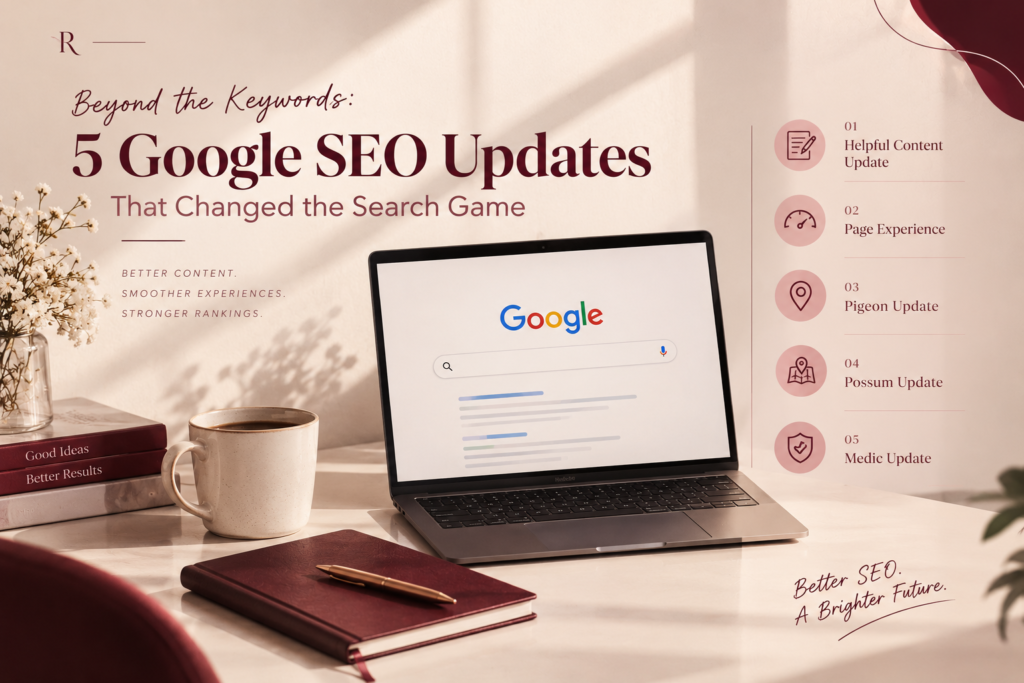
Have you ever wondered why a website ranks on the first page of Google while another struggles to get noticed? Search engine optimization (SEO) plays an important role, but rankings depend on much more than keywords alone.
Google continuously improves its search systems to deliver relevant, useful, and reliable results. Over the years, several algorithm updates have influenced how digital marketers create content, improve website performance, and optimize local search visibility.
Five notable developments are the Helpful Content Update, Page Experience, Pigeon, Possum, and Medic. Understanding their purpose can help website owners build smarter SEO strategies and create better experiences for their audiences.
1. Helpful Content Update: Write for People, Not Algorithms
Google introduced the Helpful Content Update in August 2022 to promote content created primarily for people rather than content designed mainly to attract search traffic. In March 2024, its helpfulness evaluation became part of Google’s core ranking systems.
The key idea is simple: content should answer real questions and provide genuine value.
For example, a blog explaining Instagram marketing with practical examples, original insights, and actionable tips is more useful than an article repeating generic advice
How to apply it
– Understand your audience’s search intent.
– Provide original insights and relevant examples.
– Answer questions clearly without unnecessary repetition.
– Verify facts and update outdated information.
2. Page Experience: Make Every Click Count
Google Page Experience focuses on aspects of how visitors experience a website. Important considerations include loading performance, responsiveness, visual stability, mobile usability, and secure connections.
How to apply it: Compress images, improve mobile design, reduce unnecessary scripts, use HTTPS, and test your website with Google PageSpeed Insights.
A good website should not only attract visitors but also make their journey smooth and convenient.
3. Pigeon Update: Bringing Local Businesses into Focus
Google’s Pigeon Update was introduced in the United States in July 2014. The name was given by the SEO industry. It influenced local search by connecting local results more closely with traditional web search signals and refining the role of location and distance.
For example, someone searching for a digital marketing agency in Kochi may see relevant agencies and local business listings.
How to apply it:
– Maintain an accurate Google Business Profile.
– Include relevant local information on your website.
– Keep business contact details consistent.
– Encourage genuine customer reviews.
– Create useful location-specific content where appropriate.
Pigeon highlighted the importance of helping search engines understand a business’s local relevance.
4. Possum Update: Location Makes a Difference
Possum is the industry name for a significant local search change observed in September 2016. It was associated with location-sensitive results and filtering among similar business listings.
For instance, two people searching for the same service from different neighbourhoods may see different local results. Businesses sharing an address may also experience filtering in certain searches.
*How to apply it:* Keep business listings accurate, select appropriate categories, avoid duplicate profiles, and clearly describe your genuine service locations.
Possum reminds digital marketers that local search visibility can vary depending on the searcher’s location and the context of a query.
5. Medic Update: Trust Is Part of the Story
The Medic Update refers to a broad Google core update that began in August 2018. The SEO community gave it this name because many health-related websites appeared to be affected. However, it was not an official medical-only update.
The update encouraged discussion about content quality, expertise, and trustworthiness, particularly for websites covering topics that can significantly affect people’s lives.
These ideas connect with E-E-A-T: Experience, Expertise, Authoritativeness, and Trustworthiness.
For example, an article about a medical condition should use reliable evidence, provide accurate information, and identify qualified professionals when relevant.
How to apply it: Cite trustworthy sources, demonstrate relevant expertise, correct outdated information, and avoid unsupported claims.
E-E-A-T is not a single direct ranking factor, but creating credible, reliable content supports Google’s broader goal of helping people find useful information.
Build SEO That Lasts
Google’s SEO developments show that successful optimization is about more than chasing rankings.
The Helpful Content Update emphasizes useful information, Page Experience highlights usability, Pigeon and Possum demonstrate the importance of local search, and Medic reinforces discussions about credibility and trust.
For digital marketers, the best approach is to understand the audience, publish valuable content, improve website performance, and maintain accurate business information.
Ready to Make Your Website Bloom on Google?
Want to improve your website’s visibility and build a stronger online presence? Discover practical digital marketing and SEO insights to help your brand grow.